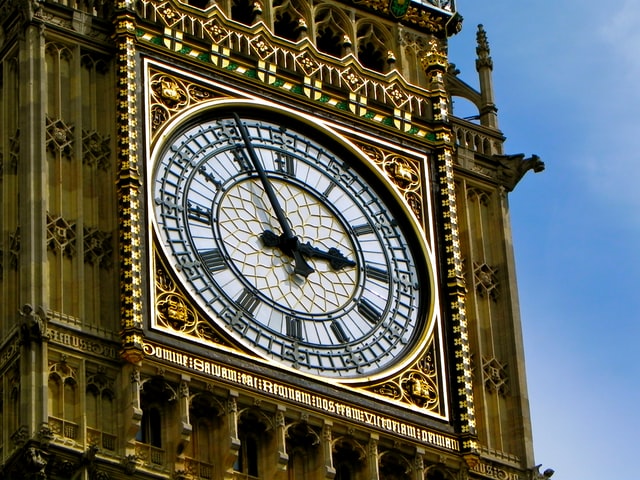
 I had just posted this clever caption under this up close and personal photo of Big Ben, the ginormous clock atop the tower in London that famously tolls every fifteen minutes with regal, penetrating tones. And out leaped the word "Domine" from an inscription just below the clock's white face. It leaped out at me because I see this word several times a day in my breviary and missal. ("Domine" means "God" in Latin.) In this instance, however, it's a prayer for Queen Victoria, evidently the reigning monarch when the iconic clock was constructed at Westminster in 1844. The inscription reads "Domine salvum fac Reginam nostram Victoriam Primum," -- "Lord, keep safe our queen Victoria the First." The purpose of this post is not to save the queen, but to present a somewhat scholarly essay I wrote for The Wanderer newspaper six years ago. We are once again at the end of the liturgical year and about to embark on another. For pious Catholics, the beginning of the new year in the Church occurs on the first Sunday of Advent, about a month and a half before the secular version on January 1. While the New Year's Eve party crowd is waiting for the stroke of midnight so they can crack open another bottle of champagne, Catholics are celebrating the Octave of Christmas and/or the Feast of Mary, Mother of God and waiting for the Three Wise Men to complete their gift-laden journey to the Christ Child on the Feast of Epiphany. Ours is a vastly different and holier goal (and doesn't leave us with a hangover on January 2.) Like the face of an old-fashioned clock, our days and hours are numbered. Let us use them wisely—for the glory of God and for souls, because "You know not the hour nor the day." (Matt. 25:13) The Sanctification of Time by Julie Ash The classic poem “If”, Rudyard Kipling’s optimistic ode to growing up, makes the unlikely promise that “If you can fill the unforgiving minute with sixty seconds’ worth of distance run, yours is the Earth and everything that’s in it—and which is more—you’ll be a man, my son!” While this frenzied definition of success may accurately depict modern life in ways Mr. Kipling couldn’t possibly have imagined, we Catholics must take a radically different approach to time management. We must order our days by the careful, prayerful use of the time that has been given to us. But how? Obviously, it is beyond the scope of this short essay to enumerate the myriad intersections of time and eternity in the Church. Fortunately, the book of Genesis offers us an important clue about how God regards time. In The Shabbat as Sanctuary in Time, Rabbi Abraham Heschel notes that the very first thing declared holy by God wasn’t a place or a person, but a day—the Sabbath.[1] Clearly, time is holy; it is a precious gift from God that should not be wasted. The ancient Greeks had two words for time: Chronos, or chronological time, and kairos, or the optimum time. Because God created and sanctified time to structure and order the life of man, we would be seriously remiss if we failed to accord to Him a certain portion of that time—a tithe of time. And not just any time, but the most acceptable time: the intersection of chronos and kairos. For he saith: In an accepted time have I heard thee; and in the day of salvation have I helped thee. Behold, now is the acceptable time; behold, now is the day of salvation. 2 Cor. 6:2 Christ’s act of redemption is the center of history and eternally present in all times. We must, therefore, make its weekly (and even daily) commemoration the center of our lives, rather than social or business interests. But this is just the beginning. Once we have begun to sanctify our week through the proper observance of Sunday—attendance at Mass, spending time with family, and rest—we can begin the process of sanctifying the entire year, and even the hours of our daily life, in accordance with the sacred liturgy. We are now at the beginning of a new liturgical year. At a homily given at Our Lady of the Annunciation of Clear Creek Abbey for the first Sunday in Advent, one of the monks[2] offered the following reflection on time: “Time has a center, and this is Christ: ‘When came the fullness of time, God sent His Son, born of a woman…’ (Gal. 4:4) … Thus the liturgical year springs from the Christian outlook on time. It is a yearly cycle, based radically upon a natural cycle, but entirely transformed and elevated by faith.” Quoting Sacrosanctum Concilium from the Catechism, he went on to explain that “In the course of the year . . . [the Church] unfolds the whole mystery of Christ. . . Thus recalling the mysteries of the redemption, she opens up to the faithful the riches of her Lord’s powers and merits, so that these are in some way made present in every age; the faithful lay hold of them and are filled with saving grace.” (SC 102, no. 1163). By reminding us of the treasures contained in the liturgical year, the Benedictines at Clear Creek are simply following in the footsteps of their renowned founder, Dom Prosper Guéranger. Writing of Advent in his monumental work, The Liturgical Year, Dom Guéranger encourages us to begin anew: He repeats His visit of this year with an untiring tenderness; He has forgotten your past slights; He would ‘that all things be new.’ [Apoc. 21:5]. Make room for the divine Infant, for He desires to grow within your soul. The time of His coming is close at hand: let your heart, then, be on the watch; and lest you should slumber when He arrives, watch and pray, yea, sing. (Ch. 3, “Practice During Advent”) Nevertheless, the sanctification of created time mandated by God and effected by His redeeming presence in history can only come to full fruition through our active union with the Church in liturgical prayer. Saint Paul exhorted us to pray without ceasing. (1 Thess. 5:17) What better time (kairos) to renew our prayer life than during the holy season of Advent? Significantly, the Catechism devotes an entire section to the subject of prayer. Despite what we may have conditioned ourselves to believe, or been led to believe by our spiritually bankrupt culture, it is always possible to pray; prayer is a vital necessity; and prayer and Christian life are inseparable (CCC 2743-2745). In the liturgy, all Christian prayer finds its source and goal (CCC 1073). The Church has been blessed with a comprehensive, all-encompassing framework for prayer in the Divine Office. As Father John Hardon beautifully explained, “The Liturgy of the Hours is no merely human form of prayer. It is nothing less than Jesus Christ praying through us, and we through Him.”[3] Each year contains the entire Catholic cosmogony, from the penultimate drama of Holy Week down to the feast of the poor souls in Purgatory. Remarkably, each week also contains the highlights of the year in microcosm: we commemorate the Passion and Death of Our Lord on Fridays; Our Lady and all of her graces, virtues, and sufferings on Saturdays; and, of course, the Resurrection of Jesus Christ on Sundays. Probing one step deeper, each hour’s recitation of the Divine Office contains within it complex polyvalent meanings, which provide an endless source for fruitful meditation on the mysteries of the life of Christ and divine revelation. The hymns and litanies of the Liturgy of the Hours integrate the prayer of the psalms into the age of the Church, expressing the symbolism of the time of day, the liturgical season, or the feast being celebrated. Moreover, the reading from the Word of God at each Hour with the subsequent responses and readings from the Fathers and spiritual masters at certain Hours, reveal the deeper meanings of the mystery being celebrated, assist in understanding the psalms, and help one prepare for silent prayer. The lectio divina, where the Word of God is so read and meditated that it becomes prayer, is thus rooted in the liturgical celebration. (CCC 1177) Because the Liturgy is thus imbued with multi-layered sacred meanings derived from the combination of divine paradigms and a vast array of historical religious artifacts, the Divine Office is not restricted to any particular language. Traditionally prayed in Latin prior to the Second Vatican Council—a practice retained by the Congregation of Solesmes of which Clear Creek Abbey is a part—it is not necessary to be a Latin scholar in order to derive great spiritual benefit from praying in this beautiful language. Mysteriously, the intention of offering one’s prayers united with the Church in the worship of God is much more important than actually understanding the words that are being said. God knows what you are saying, and why you are saying it. That is enough. Possibly, it is even better, because it allows us to focus on the intention of our actions—worshiping God as His Bride and interceding for mankind through the Body of Christ—more than the actual words themselves. While remaining faithful to the duties of our state in life, the ancient prayers of the Church contained in the Mass and Divine Office (along with the private devotional prayers that flow from them, such as the Rosary), provide us with ample means to sanctify our days. For those with hectic schedules, even one Gloria, when said with devotion in union with the Church, is of inestimable value, traveling as it does into the past, the present and the future--in principio, et nunc, et semper, et in saecula saeculorum. Naturally, the spirit of the world is violently opposed to this exalted use of our temporal resources and will do everything in its power to distract, dissuade and deter us from our goal. But we must not surrender. If we conform to the spirit of the age, our faith will stagnate and may even die. We can no longer just “go with the flow”; we must exert heroic effort to reclaim liturgically-ordered time in our own lives through persevering in love (CCC 2742) and recognizing the perfect plan of God in the annual, weekly and daily cycle of prayer in the Church. As Dom Guéranger so poignantly wrote, [P]rayer said in union with the Church is the light of the understanding, it is the fire of divine love for the heart. Prayer is man’s richest boon. It is his light, his nourishment, and his very life… Be wise, then, ye children of the Catholic Church, and obtain that largeness of heart which will make you pray the prayer of your mother. Come, and by your share in it fill up that harmony which is so sweet to the ear of God.[4] May all of us respond with open hearts to Dom Guéranger’s excellent advice, advancing along the pathways of love through the sanctification of time. [1] http://www.myjewishlearning.com/article/shabbat-as-a-sanctuary-in-time [2] It is the laudable custom at Clear Creek Abbey, for the sake of humility, not to personally identify the work of individual monks. [3] http://www.therealpresence.org/archives/Prayer/Prayer_005.htm [4] The Liturgical Year, Preface.
0 Comments
 Trigger Warning: fetal tissue research
So I was "this close" to publishing the hardcover of my Catholic novel a couple of weeks ago when an unexpected typo glitch turned up at the last moment and threw me for a loop. Total, complete brick-wall burnout. Sick to death of the whole thing. Wanted to burn it and never look at the shiny, expensive cover ever again. In desperation, I asked for prayers from many sources, but ten days went by and I still couldn't bring myself to work on it despite looming deadlines for printing and delivery before Christmas. Then yesterday I thought of something. Several chapters are set in Pittsburgh, a city I lived in and grew to love many years ago. In the novel, I laud the resiliency of its people after the downturn in the economy following the energy crisis in the 70s and the closure of nearly all of its steel mills. As one example, I wrote about how the towering U.S. Steel Building downtown was renamed the UPMC Building when that institution took it over from the failing steel industry. UPMC--as in the University of Pittsburgh Medical Center. And all of a sudden I realized that my prolife novel as currently written would give positive attention to the institution that, I just learned, claims it wants to become the "tissue hub" of fetal tissue research. (Trigger warning: Grisly details contained in this factual article from a Harrisburg, PA news site. Horrifying topic to be sure, but I am greatly encouraged by the large numbers in the young pro-life crowd protesting at the state capitol in August.) Basically, according to the above-linked article, abortions are routinely performed at UPMC, and the dying fetus is immediately shuttled to the research department, enabling them to have access to organs that are "fresh, not frozen." As in the heart was still pumping, trying to keep the little one alive. They admit as much in their grant applications to the National Institutes of Health. (Yes, dear taxpayer. Your coins to Caesar are fueling this Frankenstein-ish assembly line. Or what should more properly be called a "disassembly" line.) I can attest from personal experience that there are many excellent doctors, nurses, and staff in the UPMC hospital system. I don't want to condemn them or their healing work. But the freakish fetal research going on at Pitt has to stop. As wonderful as her people are, the city of Pittsburgh and the University of Pittsburgh/UPMC need our fervent prayers to combat this reprehensible, ghoulish abuse of the unborn. So my novel is getting a footnote to my "isn't Pittsburgh wonderful" chapter. Maybe then Our Lord will give it the green light, and I can get on with publishing this story about people dealing with, among other things, the hidden, horrific reality of fetal murder and its chilling effects on the soul. In the accelerating debate over the proper place of the Traditional Latin Mass (TLM) in the modern Church, sometimes we can't even agree on what to call it. Pope Benedict XVI, in his moto proprio Summorum Pontificum, christened it the Extraordinary Form of the Mass, as opposed to the Ordinary (meaning usual) form. The Ordinary Form is also known as the "Novus Ordo," or "New Order" of the Mass. Some call the TLM the Tridentine Rite, as it was the Mass codified into law at the Council of Trent. Recently, some are calling it the Usus Antiquior. (I think I finally got the spelling correct here.)
In other words, the basic form of the TLM goes way, way back, even beyond the Council of Trent. As such, many are choosing to refer to it as the "Mass of the Ages." Hence, the title of the incredible documentary released last month and which I have linked below. The YouTube video has nearly half a million views as of last night. I have a link to the producers' website below where you can watch the entire thing for free, thanks to the generosity of certain benefactors. Please watch if you haven't already. It's really much more than a documentary about a religious service. It's really about life and death and the choices we make. (Note the coffin in the beginning of the film.) This is serious, serious stuff, ya'll. Eternity is...forever. I don't know about you, but I plan to spend it in Heaven. To get there, I vote for the Mass that offers the most perfect, the most beautiful, and the most reverent worship possible to our God. I vote for the Mass of the Ages.  Know it or not, we all have patron saints. It may be the saint whose feast day we were born on, or a saint we especially admire. Countries, dioceses, and professions each have their own patron saint. It is claimed that in certain cases a saint will choose you. This is what happened to me with Our Lady of Czestochowa, whose feast day is tomorrow (August 26th). Our Lady of Czestochowa is the patroness of Poland. Not being Polish, I knew nothing about her growing up. I’d seen the icon of the Black Madonna, but in all honesty, I always felt a bit repelled. It looked so foreign. Our Lady looks so sad and…angry. Not a hint of a smile can be seen, at least not in the original. Other more benevolent-looking versions have been created, but they aren’t the same. As in most other icons of the Madonna, she is holding the Infant Jesus, who is similarly dark (the dark color of the icon is supposedly due to being exposed to the elements at various times in addition to incense and candle smoke.) She holds her hand over her heart, as if to say it is broken. A dark streak runs down beneath her eye as though she has been weeping. Even more distressing, her face has two long slash marks across it. Saint of My Oblation I was clothed as a novice oblate of Clear Creek Abbey in 2014. Later that year, my roommate decided to move out of state. Trying to reduce the amount of stuff she had to transport to her new home, she handed me an unframed holy card of the icon of Our Lady of Czestochowa and asked me if I’d like to have it. I said sure. I peered at the solemn face of Our Lady, stuck it in a book somewhere, and forgot about it. Earlier that year, I had been clothed as a novice oblate. After the requisite year of novitiate, I could ask to make my final promises, but I didn’t follow through. Despite my regularly attending Mass at a Benedictine Abbey, I had never really wanted to be a Benedictine, and I wasn’t finding life at Clear Creek particularly comfortable (ticks, chiggers, heat, humidity, tornadoes, skunks, potholes, flat tires—you get the idea.) I still had hopes of entering religious life, preferably as a Carmelite. But God, as He often does, had other plans. The years went by and I struggled along, trying to learn the Office and trying to pray it when I could. Before I knew it, three years had gone by, and I was still just a novice. If I didn’t make my promises soon, I could re-apply to become an oblate, but I’d have to do my novice year all over again. I didn’t want to do that, so I made my promises on August 26, 2017. Despite my initial lack of enthusiasm, I’ve never regretted it. The graces I have received, not to mention the feeling of connection with the monks and the other oblates, has gradually grown over the years into something I truly cherish and am thankful for beyond telling. After my oblation, I looked at August 26th on the calendar, but I didn’t see anything remarkable in terms of saints I could have selected as a special patron of my oblation. But Our Lady of Czestochowa isn’t on the universal calendar. I didn’t realize I had made my promises on her feast day until later. When I did, I began reading up on the story of the icon and the pivotal role she played in Polish military history—and it’s extraordinary. I won’t recount the whole thing here, but I encourage you to read it for yourself. It’s amazing. The resilient Catholicity of the Polish people today speaks volumes. Remember Jakob Baryla? Second-Hand Madonna I used to shop at a second-hand store about a half hour from my home until they stopped opening on Saturdays. Living in a mostly Protestant area, I never came across many Catholic items there. One day, I was amazed to find, you guessed it, a large poster of Our Lady of Czestochowa. But it wasn’t framed, and again, I didn’t want to look at that angry expression, so I left it there. [Slaps forehead] What was I thinking? I went back to search for it a few weeks later, but it wasn't there. Virgo Potens In the course of my spiritual journey I, like many others, have benefitted greatly from Father Chad Ripperger’s books on spiritual warfare for the laity. These books contain numerous prayers one can say to assist in reducing and eliminating demonic influences, including prayers to Our Lady under the title of “Virgo Potens,” or “Virgin Most Powerful.” I had never prayed to her under this title before except occasionally when I prayed the Litany of Loreto. I had trouble trying to imagine gentle, humble Mary as the Virgo Potens, but after reading the story of the icon, I began to see her in a different light. Cardinal Burke Leads the Way Despite all this, I still hadn’t developed a strong devotion to Mary under this title. The image was just too depressing. Then one day something remarkable happened that made me reconsider my reluctance. I had signed up to receive notifications from Cardinal Raymond Burke’s website a few years back. Somehow I got an email letting me know that His Eminence would be celebrating Mass and praying the Rosary at Jasna Gora, the location of the Shrine housing the Miraculous Icon in Poland. I didn’t have a lot of spare time, so I didn’t open the email for a couple of days. I thought it would be nice to watch the recording, even though it was obviously going to be going on in the middle of the night due to the time difference between the US and Poland. I opened the email, and to my shock and amazement, the Rosary led by Cardinal Burke at the Shrine of Our Lady of Czestochowa was starting at that very moment! I clicked on the link and there he was, and there she was. It was an incredible feeling to know that somehow, Our Lady of Czestochowa wanted me to wake up and pay attention to her. Archbishop Vigano Drops the Bomb One year after my Oblation, August 26, 2018, I opened my email before going to Sunday Mass only to discover the damning letter from Archbishop Vigano of the day before, spilling the beans on Theodore McCarrick and how deep that corrupt connection ran in the Vatican and beyond. Naively I was convinced that Pope Francis would be forced to resign. I was wrong, of course. Still, a major volley had been fired by Vigano’s willingness to risk his reputation (and possibly his life) for the sake of revealing the truth. It felt strange to be marking my first anniversary of oblation with this shocking revelation. But somehow the image of Our Lady looking sad and angry finally seemed to fit. I began to realize we were at war, and I had been conscripted. Our Lady was showing me how to take a hit and keep going. It was going to be a long haul, and I needed to toughen up. Terrible as an Army in Battle Array In the traditional Office, I learned to pray the following verse from the Canticle of Canticles, Chapter 6, in honor of Our Blessed Mother: [9] Who is she that cometh forth as the morning rising, fair as the moon, bright as the sun, terrible as an army set in array? This description of Our Lady (or the Church) as a formidable military leader appears twice, not only at verse 9, but just above it at verse 3: [3] Thou art beautiful, O my love, sweet and comely as Jerusalem: terrible as an army set in array. In other words, Mary is much more powerful than she is given credit for in some circles. We have this image of Our Lady as a sort of pious, simple maiden who was pure and humble and good. She is all those things, of course. But she is also the Woman Clothed with the Sun (see Apoc. Ch. 12). She is the Woman Who Will Crush the Head of the Serpent. She is the Virgo Potens, and we desperately need her intercession in these troubled times. She is fighting for the Church. Are you feeling wounded lately? Turn to her. Give your sufferings to her. She will fight for you as well. My Immaculate Heart Will Triumph Triumph. Triumph is a quasi-military term. As in winning the war. As in defeating the enemy. In Heaven, the Church is Triumphant. I thought of Our Lady of Czestochowa again a few weeks ago when I read the announcement in the Boston Globe that Theodore McCarrick is about to be arraigned in court in Massachusetts for crimes committed while holding a position of trusted authority in the Catholic Church. He will finally have to face the judge. He can no longer hide. The date of his arraignment? August 26th. What a coincidence. But I no longer believe in coincidences.  So as we come to that date in the calendar this year, I invite you to meditate on the face of Our Lady as represented in the icon of Our Lady of Czestochowa. I urge you to contemplate the wounded face and neck, the steely gaze, the resolute chin. In her loving heart pierced by a sword so that the thoughts of many hearts might be revealed, the heart whose blood flowed to the Heart of Jesus growing in her womb and which was shattered by grief on Good Friday, she holds the Church and the world in a mother’s embrace and vows to defend us, and her Son’s honor, with a mother’s fiercely protective love. Every time one of her children is wounded, she is wounded as well. And how many are those wounds? Scandals, divisions, and sacrilege are rife. And yet, she doesn’t dissolve into tears of self-pity. She doesn’t run and hide in the background until it’s all over. Rather, she leads us boldly into battle, and she promises the victory—the Triumph—to all those who love and serve Her Son. They tried to destroy her at Jasna Gora, and they are trying to destroy her today. But they will fail. Hail, Full of Grace. Hail, Holy Queen. Oh Virgin Most Powerful, Our Lady of Czestochowa, pray for us who have recourse to thee.  *Theodore McCarrick's arraignment date has been moved back to September 3.  Sheep safely grazing near Mont Saint-Michel, France Photo by Alexey Komissarov from Pexels We are at war. We fight against the blatantly satanic culture, an eerily unpredictable virus, and criminally corrupt religious and political potentates. And now the various factions of Catholicism, like the various factions of American government—liberals, conservatives, and trads—are fighting each other. Not with bombs and bullets, but with words. How does one cope with an endless war of comments, memes, and clicks? Fact checkers and Facebook jail? Not to mention the ever-present specter of The Virus from Hell and attempts to eradicate it and/or profit from its eradication, which are almost as bad, if not worse, than the illness itself. Where is the Peace of Christ is all of this chaos? The Benedictine Way Personally I hate conflict, but I’ve always been something of a zealot. Perhaps that’s why I always wanted to become a Carmelite. Besides wanting to be like Teresa and Therese, the seal and motto of the Carmelite order greatly appealed to me: “With Zeal I Have Been Zealous for the Lord God of Hosts”; the arm of Elijah raised high, sword in hand, ready to chop off the heads of the priests of Baal on Mount Carmel. God, however, as He often does, had other plans, and I found myself a Benedictine oblate. As such, I am duty-bound to “seek peace and pursue it,” in the words of St. Benedict, who got it straight from none other than St. Peter (1 Peter 3:11) and from Psalm 33. So we have an unbroken directive from God going back all the way to King David by way of the first pope. Might be worth considering, even if you’re not a Benedictine. Even the Medal of Saint Benedict—you know, the one justly famous for warding off demonic influences— has the word “PAX” in all caps at the top: “peace.” And not just any peace, but the peace that “surpasseth all understanding”, in the words of St. Paul: the Peace of Jesus Christ. It surpasses the understanding because who can be peaceful when everything is falling apart and you’re getting blamed for it, you judgmental trad, you? Who can be peaceful when very your way of life is under attack from leftists and liberals and COVID, oh my? You can, dear fellow Catholic. That’s who. Advice from a Priest I had been thinking about writing an essay on the topic of peace for some time. Then on Tuesday, I received a group email from Father Paul N. Check, Rector of the Shrine of Our Lady of Guadalupe in Wisconsin, regarding Cardinal Burke’s serious medical condition. If you’re like me, the sad news of His Eminence’s being ill to the point of being on a respirator due to the infernal virus, especially coming so close on the heels of Traditionis Custodes, followed last week by the Haiti earthquake and now the fall of Kabul, God help us, was a real gut-punch. Father Check eloquently and encouragingly describes the attitude that should be adopted by the faithful in this and other stressful situations in the Church and the world. Having confidence in God and frequenting the sacraments is a sure pathway to the peace of Christ, our only hope in times of trouble (and these are troubled times, as I am sure anyone would wholeheartedly agree.) I hope he won’t mind if I borrow from his letter: “Peace I leave with you; my peace I give to you; not as the world gives do I give to you. Let not your hearts be troubled, neither let them be afraid. (Jn 14:27) “Nothing falls outside of God’s providence. Nothing falls outside the reach of His grace. These are spiritual truths we know and that the Cardinal has taught us by his own example of fidelity in trust and surrender to the Good God. Confidence in these truths opens us to the peace the world cannot give or take. Were he able to speak with us now, he would tell what he has always taught us: that Our Father in Heaven is good, merciful, just, provident and sovereign; that we are His beloved children and that He will never leave us orphans; that we should not be afraid of the Cross as the way to eternal life; that the Sacraments are the most direct channels of grace and that we do the soul the greatest good by receiving Holy Communion often and by going to Confession regularly; that we should say our daily prayers; and that we should love one another as Jesus Christ has loved us: generously, even to the point of heroic sacrifice. “And one more thing so important and so dear to His Eminence: that we should pray the Rosary frequently and fervently, and so place ourselves under the mantle of Our Lady, confident in her maternal love and intercession.” Father Check is one-hundred-percent correct. God Wills It for Us The Holy Mass offers prayers for peace numerous times. Someone has probably counted the exact number, although I do not know what that number is. Let’s just say it’s a prayer of priority, asking Our Lord to grant us His peace. Dona nobis pacem. After the Resurrection, when he appeared to His apostles, He stood in their midst and said, “Peace to you. It is I, fear not.” (Luke 24:36) Some may say that this was just the standard Jewish greeting, “Shalom,” like the Arab version, “Salaam.” But I don’t think so. I think Jesus wants His children to be peaceful and trusting, like gentle lambs, like docile sheep, not like the quarreling, head-butting goats we so often resemble.  God Grant Me the Serenity to Accept the Things I Cannot Change I get it. Most of the things one reads or hears online anymore can inflame the passions to the point we start lashing out in mean tweets, sarcastic comments, and other non-Christian behavior. We feel it’s all outside our control, and we want to be heard. Or we turn the anger inward, and find ourselves sad, anxious, and depressed. That’s when our unhealthy addictions kick in. Satan is more than happy to assist. One more won’t hurt. You need this to relax so you can get your rest. You deserve a break. And the worst one of all: No one will know. This is deadly poison, not only for our own mental and physical health and that of our loved ones, but for our relationship with the Lord, who desires our trusting confidence and growth in holiness. If the blogs and the videos and the news reports make you crazy, maybe it’s time to turn them off, or greatly reduce the time spent on them. If you’ve tried and tried and are still struggling, consider contacting a counselor or other mental health professional. There are good Catholic counselors in many areas, and if there aren’t any where you live, look for those who are willing to see patients online or by telephone. If you can’t afford a counselor, you might have luck joining a 12-step group (are there 12-step groups for internet addiction, I wonder? If there aren’t, there should be.). Sometimes just knowing you aren’t the only one fighting an addiction works wonders. Don’t give up. Seek Peace and Pursue It For the rest of us, when it all gets to be too much, rather than indulge our irascible appetites, we must bite our tongues, turn off our phones, walk away from our blistering keyboards, tell the negative chattering demons in our heads to shut the hell up, and offer up our suffering. And as a very wise monk told me in Confession recently, when someone angers and annoys you, pray for the grace to see that person (and ourselves) as Our Lady does. I’m guessing she looks on us with love, even though we make her weep. Love your enemies. Oh Lord, even that one? How many times must I forgive? Seven times? If we spent as much time praying for our erring brothers and sisters as we do vilifying them online, things could change. Speak softly and carry your Cross. Blessed are the peacemakers: for they shall be called the children of God (Matt 5:9). In Verdant Pastures He Gives Me Repose Then after you’ve unplugged the internet demons, do something that has been calming to you in the past. Make a holy hour. Take a shower, take a walk. Listen to some Gregorian chant, watch a silly old movie, call a friend. Pet your dog and hug your children. Tell your spouse you love him or her. (They might be stressed out, too.) Go easy on the caffeine. Be sure to keep the Sabbath day of REST. And remember to thank God for all the good things in your life. If you can’t think of anything, start with the basics. Are you breathing? That’s something to be thankful for. The Holy Trinity is not going to dwell for long in a heart filled with anger and resentment. It behooves us, therefore, to pray diligently for the peace of Christ, for ourselves and for others, even when it’s hard—especially when it’s hard. Offer it up for the restoration of the Church and for the recovery of our beloved Cardinal Burke. And not only for him, but for all the other cardinals, bishops, priests, and religious who so desperately need our prayers and sacrifices—both the erring and the devout. A peaceful mind thinks more clearly and rationally, and a peaceful heart loves more readily. Then we will have the victory in this hellish war against Christ and His holy Church—a war that has already been won by the Prince of Peace. “Pray ye for the things that are for the peace of Jerusalem: and abundance for them that love thee. Let peace be in thy strength: and abundance in thy towers. For the sake of my brethren, and of my neighbors, I spoke peace of thee. Because of the house of the Lord our God, I have sought good things for thee.”– Psalm 121:6-9 Official updates on Cardinal Burke’s condition can be obtained here: https://guadalupeshrine.org/cardinalburkenews |
Archives
November 2026
Categories
All
The opinions expressed on this website are my own personal views and do not necessarily represent those of the Catholic Church.
If I have erred in any statement, whether directly or by implication, in any matter pertaining to faith or morals, I humbly invite fraternal correction. |

 RSS Feed
